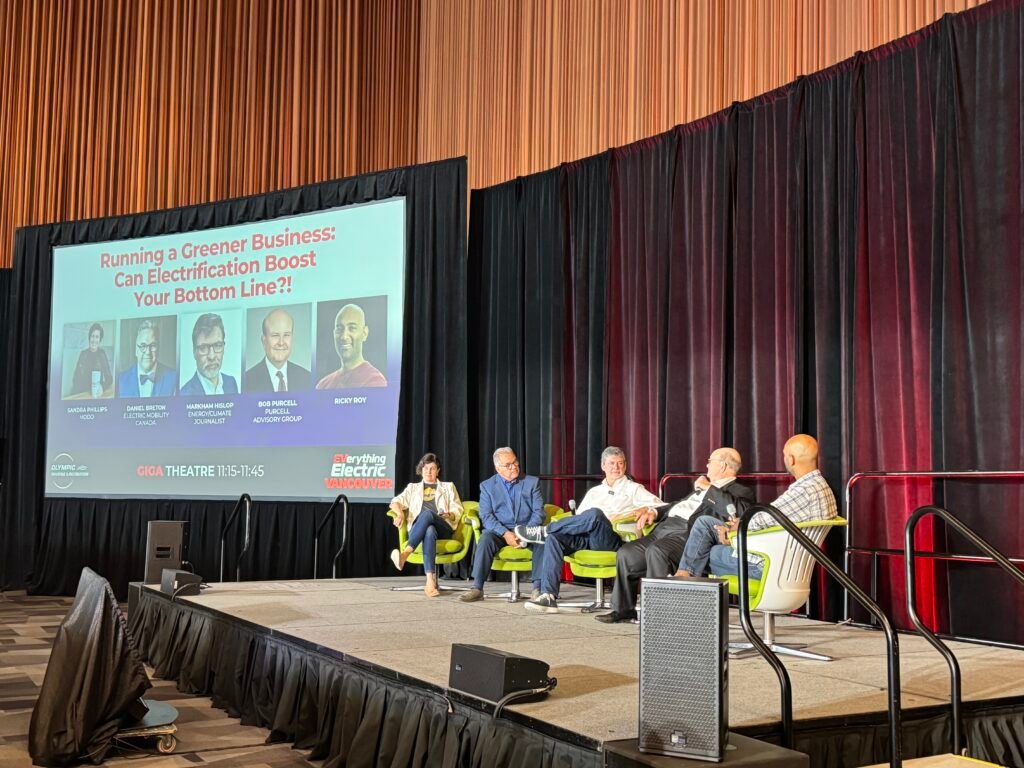
Our recent conversation with Bob Purcell—the legendary auto executive who launched the GM EV1 and has since advised Warren Buffett’s Berkshire Hathaway on transportation investments—generated more interest than any blog post in Plunk EV’s history. Readers wanted more. So here it is: the extended conversation where Bob digs into the real lessons of the EV1, why fast charging is overhyped, how Canada can become a clean energy exporter, and what he tells Kent Rathwell when they talk strategy.
Part One: The Real Story of the EV1
Plunk EV: Bob, the documentary “Who Killed the Electric Car?” painted GM as the villain in the EV1 story. You were there. What really happened?
Bob Purcell: That documentary did a lot of good getting people fired up about electric vehicles, but it told a Hollywood story, not the real story. The real story is more complicated—and honestly, more interesting if you’re trying to learn from it.
When I took over the program in 1994, GM had invested serious money but wasn’t sure there was a business there. My job was to answer two questions: Can we make it work? And can we make money? We answered the first one pretty definitively. The EV1 was a technological masterpiece—most aerodynamic production car ever built, first automotive heat pump, first electro-hydraulic regenerative braking system. We set land speed records. Popular Science called it the world’s best electric car.
The second question was harder. Battery technology wasn’t where it needed to be. We were making progress—the nickel-metal hydride batteries doubled our range—but lithium-ion wasn’t ready for automotive use yet. We were ahead of our time by about fifteen years.
Plunk EV: Do you think GM made a mistake killing the program?
Bob Purcell: I think GM made a business decision that looked rational at the time and turned out to be short-sighted. They looked at the economics in 2002 and said, “We can’t make money on this.” They were right about 2002. They were wrong about 2012 and 2022.
But here’s what I tell people: don’t blame GM and miss the lesson. The lesson is that new technology requires patient capital and long-term thinking. Tesla almost went bankrupt three times before they cracked it. The only reason they survived is that Elon was willing to bet everything, over and over again. Most corporations can’t do that—their shareholders won’t let them.
That’s why what Kent has built is so important. He funded the longest green highway in the world out of his own pocket. No committee. No board approval. He just did it because he knew it needed to be done. That kind of founder commitment is rare, and investors should pay attention to it.
Part Two: The Charging Infrastructure Problem Nobody Talks About
Plunk EV: Everyone’s talking about range anxiety and the need for more fast chargers. You’ve been skeptical of that narrative. Why?
Bob Purcell: Because it’s based on thinking about EVs like they’re gasoline cars. That’s the wrong mental model.
Here’s how most people think: “I fill up my gas tank at a gas station, so I’ll need to charge my EV at a charging station.” That leads you to fast chargers on highways, which leads you to massive capital expenditure, which leads you to business models that don’t work without government subsidies.
Here’s the right way to think about it: Where does your car spend 95% of its time? Parked. Where does it park? At your home, at your workplace, at stores, at restaurants, at hotels. What if you could charge at all those places, slowly, while you’re doing other things? Then you’d never need to “go charging” the way you “go get gas.”
That’s the Plunk EV model. Level 2 chargers at destinations. Free to use. You show up, you plug in, you go shopping or have dinner or check into your hotel, and when you come back your car has more charge than when you left. No range anxiety because you’re always topping off.
Plunk EV: But won’t we need fast chargers for long road trips?
Bob Purcell: Sure, for true long-distance travel. But what percentage of trips are genuine long-distance? For most people, it’s a handful of times a year. You don’t build your entire infrastructure strategy around the exception.
Here’s a number that should make every fast-charging investor nervous: utilization. Most DC fast chargers in North America are sitting idle 80-90% of the time. You’ve got a $150,000 piece of equipment that’s being used four hours a day. The math doesn’t work without subsidies or very high charging fees—which then makes the value proposition for EV drivers worse.
Level 2 charging is the opposite. Lower capital cost. Higher utilization because people park for hours. Easier installation. And if you do it right, like Plunk EV does, you’re creating value for the host site because you’re driving traffic to their business.
Plunk EV: You mentioned battery storage. How does that fit into Plunk EV’s model?
Bob Purcell: This is where it gets really interesting, and this is why I tell people Plunk EV is building an ecosystem, not just installing chargers.
When you add battery storage to a site, you’re not just solving the “how do we power these chargers” problem. You’re creating a grid asset. That battery can provide demand response. It can do peak shaving for the host. It can participate in grid services markets. It can provide backup power during outages.
Suddenly your charger site isn’t a cost center—it’s generating multiple revenue streams. Charging. Grid services. Demand management. Maybe even arbitrage if you’re buying power at off-peak rates and selling services at peak times.
The hosts love it because it lowers their electricity costs. The grid loves it because it adds distributed storage. Investors love it because you’ve got diversified revenue. And drivers love it because the chargers are free. That’s what I mean by an ecosystem—everybody wins because the pieces work together.
Part Three: Why Canada, and Why Now
Plunk EV: You’ve worked with companies all over the world. What makes Canada special for EV infrastructure?
Bob Purcell: A few things. First, you’ve got abundant clean electricity. Hydro in Quebec and British Columbia. Nuclear in Ontario. When a Canadian plugs in an EV, they’re driving on genuinely clean power. In a lot of the United States, you’re just moving the emissions from the tailpipe to the coal plant.
Second, Canadians actually drive long distances. The Trans-Canada Highway is over 8,000 kilometers. When Kent proved you could drive it coast to coast in an EV in winter—in 2012, with the technology that existed then—he proved something that matters. If it works in Canada, it’ll work anywhere.
Third, and this is strategic: Canada has an opportunity to become an exporter of EV infrastructure expertise. Kent’s already done this with Sun Country Highway—installed chargers across the U.S., partnered with hotel chains and retail chains internationally. There’s no reason Plunk EV can’t be a global company. The knowledge base is there, the track record is there, and the model is proven.
Plunk EV: What do you see as Canada’s biggest challenge in the EV transition?
Bob Purcell: Same as everywhere: getting the infrastructure ahead of the adoption curve instead of behind it. You need chargers before people will buy EVs, but investors want to see EVs on the road before they’ll fund chargers. It’s a chicken-and-egg problem.
That’s actually what Kent solved when he built the Sun Country Highway network. He didn’t wait for demand to prove the market. He created the infrastructure and let the demand follow. Same philosophy applies now with Plunk EV. Get the chargers and storage in place, make them free and easy to use, and the EV adoption will accelerate.
The Canadian government has ambitious EV targets. They’re going to need private-sector partners who can actually deploy infrastructure at scale without depending on government funding for every site. Plunk EV’s model—where the hosts and the grid services cover the costs—is exactly what that transition needs.
Part Four: Working with Kent Rathwell
Plunk EV: You’ve worked with a lot of entrepreneurs and executives over your career. What stands out about Kent Rathwell?
Bob Purcell: Kent’s what I call a “true believer who can also do math.” That’s rare. A lot of people in the sustainability space have the passion but not the business acumen. A lot of business people have the financial sophistication but don’t really care about the mission. Kent’s both.
When I first met him, I was impressed that he’d funded the longest green highway in the world out of his own pocket. That tells you something about conviction. But what really got my attention was how he thinks about business models. He’s not trying to build a charity. He’s trying to build a system where sustainability is the profitable choice—where hosts want chargers because it helps their bottom line, not because they feel guilty about climate change.
That’s the only way this stuff scales. You can’t guilt people into changing the world. You have to make it economically attractive. Kent gets that.
Plunk EV: What do you two talk about when you’re advising the company?
Bob Purcell: Strategy, mostly. How to scale without breaking what works. How to communicate the model to investors who are used to thinking about infrastructure in traditional ways. Sometimes technology questions—I’ve been doing this a long time, so I’ve seen what works and what doesn’t at the component level.
But honestly, Kent doesn’t need much hand-holding. He knows his business. What I try to bring is perspective from other industries and other eras. The lessons from the EV1 still apply—the importance of systems thinking, the danger of building something that’s too early for its market, the value of proving things in the real world instead of just on paper.
The main thing I tell him is: keep your eye on the fundamentals. There’s going to be a lot of noise in this industry—companies raising huge amounts of money, splashy announcements, government programs that come and go. The companies that win will be the ones that build real value for real customers. Plunk EV is doing that.
Part Five: Advice for Investors
Plunk EV: You’ve advised institutional investors, venture capital firms, and strategic investors in the energy and transportation space. What’s your advice for someone evaluating the EV infrastructure sector today?
Bob Purcell: First, be skeptical of anything that requires permanent subsidies to work. Government programs are great for getting industries started, but if a company’s unit economics depend on incentives that might change with the next election, that’s a red flag.
Second, look at the management team’s actual experience. Have they installed chargers? Do they know what happens when a unit fails in the field? Have they negotiated with utilities and hosts? This isn’t an industry where you can fake expertise. Kent and his team at Plunk EV have been doing this since 2012. They’ve made every mistake you can make and learned from them. That institutional knowledge is incredibly valuable.
Third, understand the difference between selling hardware and building a network. Hardware is a commodity—prices come down, competition increases, margins compress. Networks get more valuable as they grow because of the relationships, the data, the ecosystem effects. Plunk EV is building a network.
Fourth, think about alignment of incentives. In Plunk EV’s model, the hosts benefit, the drivers benefit, the grid benefits, and the company benefits. When everybody’s interests are aligned, good things tend to happen. When you’ve got a model where you’re extracting value from one party to benefit another, eventually something breaks.
And finally, look for founders who have skin in the game. Kent invested his own net worth to prove this concept when nobody else believed in it. That kind of commitment doesn’t guarantee success, but it sure increases your confidence that the team is going to fight through the hard times.
Plunk EV: What’s your long-term outlook for EV infrastructure as an asset class?
Bob Purcell: Extremely positive, if you invest wisely. Transportation is going electric—that’s not a prediction anymore, it’s a fact. Every major automaker has committed billions of dollars. Governments around the world are setting deadlines for combustion vehicle phase-outs. The economics of EVs are reaching parity with combustion vehicles and will keep improving.
All those EVs need to charge. The infrastructure to support them is going to be worth hundreds of billions of dollars globally. The question isn’t whether there’s opportunity—it’s which companies will capture it.
My bet is on companies like Plunk EV that understand the whole system, that have sustainable business models, and that are led by people who’ve been doing this long enough to know what actually works. Those are the companies I want to be associated with.
Bob Purcell is a member of Plunk EV’s Advisory Board. He is the founder of Purcell Advisory Group and former General Manager of GM’s Advanced Technology Vehicles Group, where he led the team that launched the EV1. He has advised major energy and transportation investors including MidAmerican Energy Holdings (a Berkshire Hathaway company), Oak Investment Partners, and Delphi Automotive. He received the “Technology Pioneer” award from the World Economic Forum at Davos and multiple General Motors Chairman’s Honors Awards.