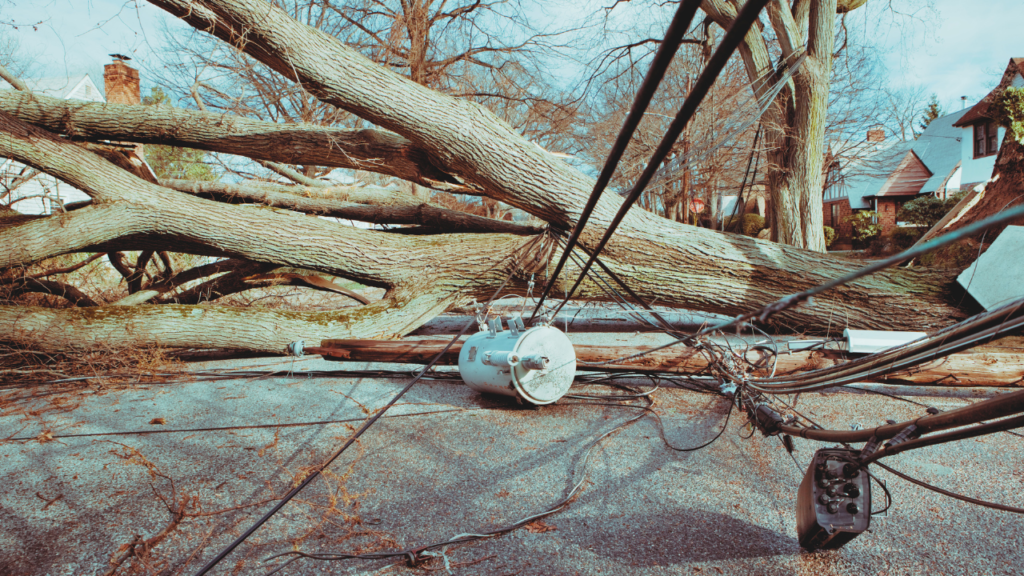
In late September 2022, post-tropical storm Fiona did something Atlantic Canada had not seen before. At its peak, more than 405,000 Nova Scotia Power customers were without electricity — the highest number on record — and in Prince Edward Island, all 82,000 Maritime Electric customers lost power at once. The headline figures are arresting on their own. The recovery timeline is what should keep grid planners awake at night.
In every Nova Scotia region, it took at least two full weeks from the first outage to restore power to the last customer. The hardest-hit areas fared worse: the northeast, around Pictou and Antigonish, ran 16.81 days from first outage to full restoration, with Cape Breton East close behind at 16.63 days. On PEI, roughly 3,100 customers were still in the dark eighteen days after landfall. This was not a one-off. Hurricane Juan in 2003 took about fifteen days to restore; Dorian in 2019 took around ten. The trend line is moving in the wrong direction as storms intensify.
These are not “outages” in the sense most backup planning assumes. A diesel generator and a few hours of fuel address a blackout measured in hours. They do not address a blackout measured in weeks. And as more of daily life — heating, communications, refrigeration, and increasingly transportation — runs on electricity, the cost of a multi-day grid failure compounds quickly.
The duration problem the grid hasn’t solved
For most of the last decade, “energy storage” has effectively meant lithium-ion batteries sized for four hours or less. That makes sense for the jobs lithium-ion does well: smoothing peaks, providing frequency response, and shifting a few hours of solar into the evening. The IEA’s 2026 Global Energy Review confirms how dominant this has become — 108 GW of new battery storage was deployed worldwide in 2025, 40% more than the year before, with lithium-iron-phosphate chemistry accounting for around 90% of installations.
But a four-hour battery is no answer to a fourteen-day outage. That gap — between what the grid stores today and what genuine resilience requires — is exactly where long-duration energy storage (LDES) is finally maturing.
The most striking development is in iron-air chemistry. In February 2026, an MIT team published work in Nature Energy describing an iron-air battery that can store electricity for up to 100 hours at roughly one-tenth the cost of lithium-ion, achieving 72% round-trip efficiency over 3,000 cycles. A companion review in Advanced Sustainable Systems the same month made the broader case for the chemistry: iron and oxygen are earth-abundant, inherently non-flammable, and carry minimal environmental footprint. Independent technology analysis published in April 2026 positions iron-air as the only pathway to sub-$50/kWh storage for 100-hour-plus seasonal duration — though it cautions that commercial deployment is not expected before 2027.
The economics are starting to favour duration, too. An LCP Delta study released in April 2026 found that replacing two gigawatts of gas-fired capacity with 18-hour storage systems could save roughly €90 million annually in subsidies while maintaining equivalent baseload capacity. Wood Mackenzie reported that LDES installations reached 15 GWh in 2025, up nearly 50% — still only 6% of all storage built, but climbing fast.
Why distribution matters as much as duration
Here is the part the headlines about giant batteries tend to miss. During Fiona, the failure was not primarily a generation shortfall. It was physical: downed lines, snapped poles, and roads that crews could not reach for days because of debris and high winds. Nova Scotia’s grid is largely above ground, with more than half a million poles exposed to exactly the kind of wind and falling trees that storms deliver.
A single large storage facility, however long its duration, sits on the wrong side of that broken distribution network. If the lines between the battery and the customer are down, stored energy does not reach the people who need it. Resilience in a storm is as much a question of whereenergy is stored as how long it can be stored.
This is where the logic of distributed infrastructure becomes compelling. Energy resources sited close to where people actually are — at commercial sites, community hubs, and the places drivers already gather — can keep critical loads running even when the wider grid is severed. Pair that distribution with longer-duration chemistries, and the multi-day outage stops being a catastrophe and becomes an inconvenience.
The same principle scales all the way down to the individual home. Rooftop solar paired with a residential battery is the most decentralized form of resilience there is: a household that generates and stores its own power does not depend on a single pole standing or a single line holding. During Fiona, a home with panels and a battery could have kept its refrigerator cold, its furnace fan running, its phones charged, and — critically — essential home medical equipment such as a CPAP machine or home dialysis unit operating through days when the street outside was still impassable. The battery rides through the night and recharges from the sun the next morning — a self-contained loop that simply does not care whether the utility’s distribution network has been restored yet. As batteries get cheaper and longer-duration chemistries arrive, the residential layer becomes a genuine floor under household safety rather than a luxury add-on, and a grid made of thousands of such homes is one that degrades gracefully under stress instead of failing all at once.
Where charging infrastructure fits
At Plunk EV, our model puts charging hardware in the ground across hundreds of host sites — and that footprint is, in effect, a distributed grid-edge asset. The chargers themselves are the visible layer. The siting, the host relationships, the grid interconnections, and the deployment logistics underneath them are the harder thing to build, and they are precisely what a resilient, distributed storage future will need.
That same distributed logic extends directly into the home. Alongside our charging infrastructure, Plunk supplies 15 kWh and 30 kWh residential battery systems designed to give homeowners genuine islanded resilience — the ability to disconnect from the grid entirely and run on stored power when the lines come down. Paired with rooftop solar, a 30 kWh system can carry a household’s essential loads through the kind of multi-day outage Fiona inflicted, recharging from the sun each day while the utility works to rebuild the poles and lines outside. Islanding is the key word: when the distribution network fails, these homes do not wait for it. They simply keep running on their own.
As LDES chemistries move from the lab toward commercial deployment over the next few years, the sites that already have power infrastructure, grid connections, and community presence are the natural points to integrate it. A charging host today is a candidate storage node tomorrow. The same locations that let drivers top up on clean energy can, with the right pairing, become the places that keep a freezer running and a phone charged when the lines come down for two weeks.
The planning question for Atlantic Canada
Fiona should reframe how the region thinks about backup. The relevant design question is no longer “how do we keep the lights on for a few hours?” It is “how do we keep critical services running for two weeks when the distribution network itself fails?”
Long-duration storage answers the duration half. Distributed deployment answers the location half. Neither is sufficient alone, and the research arriving in 2026 suggests the duration half is closer to commercial reality than it has ever been. The infrastructure being built now — close to people, tied into the grid, designed to scale — is what will determine whether the next Fiona is a fortnight in the dark or something far more manageable.
The figures in this post draw on Nova Scotia Power and Maritime Electric public reporting on Fiona, the IEA Global Energy Review 2026, and 2026 long-duration storage research and market analysis from MIT, Wood Mackenzie, and LCP Delta.