The first banks weren’t complicated. Someone with surplus grain stored it securely. Someone else who needed grain now but would have surplus later could borrow. The intermediary took a cut for providing the service. That simple innovation – storage plus intermediation plus time-shifting – transformed human civilization.
Battery storage is doing the same thing for electricity. And like the emergence of banking in ancient economies, it’s not just adding a feature to the existing system – it’s enabling an entirely new economic logic.
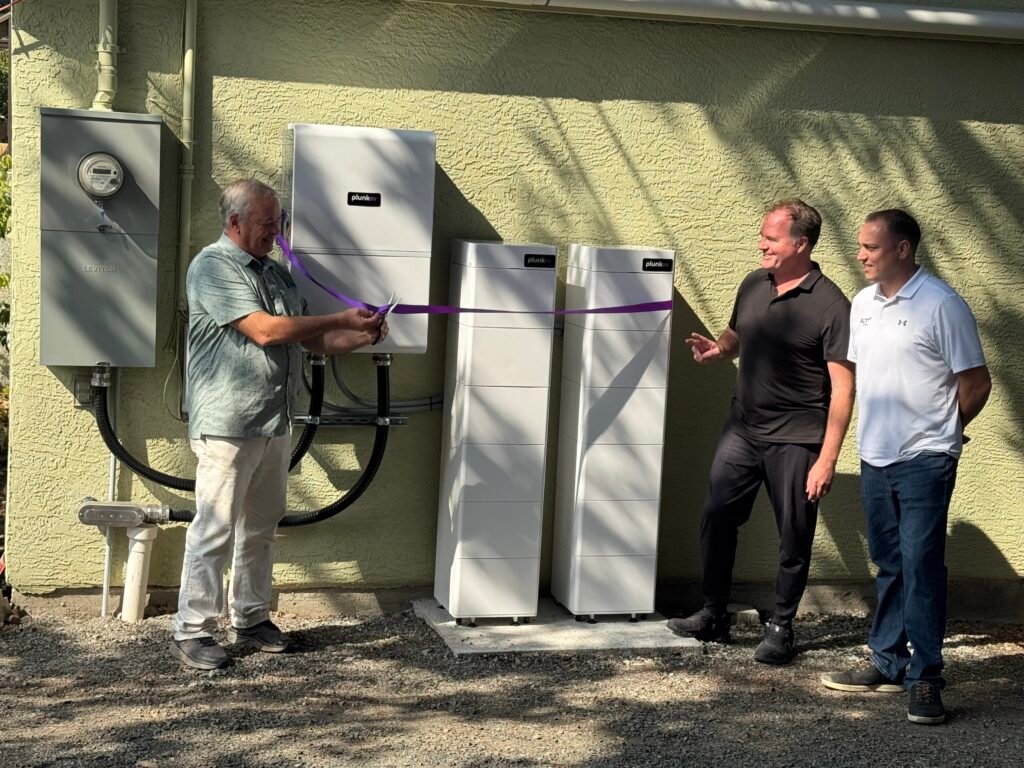
Home batteries are personal savings accounts. A Plunk BESS, a Sonnen unit, a BYD battery in your garage – these are your energy savings accounts. Solar panels generating more power than you need at noon? Deposit the surplus. Withdraw it at dinner time when grid rates are high, or during an outage when the grid has nothing to offer. You’re no longer at the mercy of real-time generation. Your electrons can wait… for when you need them.
In Australia, the Sonnen community has taken this further – thousands of home batteries networked together, with members earning credits when their stored energy helps meet system demand. It’s not just saving; it’s savings that earn interest.
Grid-scale batteries are institutional reserves. South Australia’s response to its 2016 blackout was to commission the world’s largest lithium-ion battery: Tesla’s Hornsdale Power Reserve, capable of injecting 150 megawatts into the grid within milliseconds. Faster than any gas turbine could spin up. More reliable than any human operator could react.
The results were immediate and dramatic. The battery paid for itself within two years by providing frequency control services – the electrical equivalent of a central bank smoothing out currency fluctuations. South Australia went from cautionary tale to global model. Victoria, Queensland, and New South Wales have followed with their own big batteries. The UK has deployed gigawatts of grid storage. Germany’s Next Kraftwerke operates one of Europe’s largest virtual power plants, aggregating over 10,000 distributed assets.
These aren’t just batteries; they’re the reserve banks of the electrical system. They hold deposits from times of surplus and release them during scarcity. They provide the buffer that allows the rest of the system to operate with less redundancy and less waste.
The fundamental transformation: electricity becomes a durable asset. For over a century, a kilowatt-hour has been the most perishable commodity imaginable – spoiling not in days or hours but in milliseconds. Storage changes the physics, or at least the economics. You can “deposit” energy when it’s abundant and cheap, then “withdraw” it when it’s scarce and valuable. Time-shifting becomes possible. Arbitrage becomes possible. For the first time, electrons can be saved.
The Uppsala University researcher Per Ribbing has explicitly explored this parallel, arguing that the banking analogy helps people grasp how modern electrical systems actually work. We intuitively understand that our deposited banknotes don’t sit in a vault waiting for us – they get mixed with everyone else’s money, lent out, invested, and the bank just owes us the value. The same logic applies to electrons on a grid with storage: your solar generation at noon might power your neighbor’s air conditioning, while the battery power you draw at 6 PM might come from a wind farm that generated it overnight. The grid becomes a bank, not just a delivery network.
But here’s what makes this moment truly revolutionary: we’re not just replicating basic banking. We’re watching the entire financial infrastructure emerge in compressed time.
Savings accounts came first – home batteries, grid-scale storage, the ability to defer consumption. But once that foundation exists, more sophisticated instruments inevitably follow. Lending and credit. Pooled investment vehicles. Peer-to-peer transfers. Derivatives and arbitrage. Market-making and intermediation.The energy banking system isn’t coming. It’s already being built, one installation at a time, across rooftops in Perth, apartment blocks in Berlin, parking lots in Oslo, and substations from Adelaide to Aberdeen. And Plunk EV is bringing it to Canada.
Further reading: Ribbing, P. (2018). “On the Analogy Between the Electric Grid and Our Banking System: Investigating ‘Consumer Power’ in Deregulated Power Markets.” International Journal of Earth and Environmental Sciences, 3: 154.
Congressional Research Service (2019). “Electricity Storage: Applications, Issues, and Technologies.”